
'I do believe there will be a resolution in the next couple of months on the penal tariff and hopefully on the reciprocal tariff also.'

Prime Minister Narendra Modi and Chinese President Xi Jinping are set to meet in Tianjin on Sunday, their first in about 10 months, for wide-ranging talks aimed at improving relations.
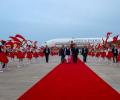
Prime Minister Narendra Modi arrived in China for the Shanghai Cooperation Organisation (SCO) summit. His meeting with President Xi Jinping is significant given global economic concerns.

'Geopolitically and diplomatically it's a very difficult situation for India.'

'If Washington has to balance Chinese power, she will have to turn to the third biggest power in the world which is India.' 'The United States and India will have to work together in order to keep Chinese ambitions in check.'
Waltz after being elected as the Co-Chair of India Caucus in January last year had said that India is the world's largest democracy and an important strategic partner for the United States.
'We are a responsible nation, and would prefer to deal with sensitive issues with the maturity they deserve rather than take to social media.'

Ask rediffGURU Naveenn Kummar your insurance mutual fund and personal finance-related questions.
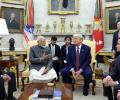
Trade, defence cooperation and regional strategy had long formed the backbone of India-US ties, but the latest rift shows how quickly those pillars can be shaken by personal grievances and political optics.
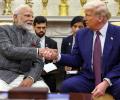
Amid trade tensions between Delhi and Washington, the NYT article gives an account of how relations between Trump and Modi "unraveled" after Trump's repeated claims of solving the four-day conflict in May between India and Pakistan, an assertion denied by India.

The Gems and Jewellery Export Promotion Council (GJEPC) has urged the Centre to provide immediate relief measures as the tariffs imposed by the United States have started hitting the industry. US tariffs of 50 per cent on Indian goods came into effect on August 27.

The statement did not name any country. But the US has often blamed India and China for purchasing Russian oil even when there are no tariffs on Beijing for it.

'However, we must implement a tit-for-tat approach -- reciprocating their conduct with precision.' 'If they demonstrate respect, we respond accordingly. If they adopt hostile positions, we mirror that hostility with equal intensity.'
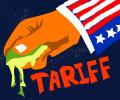
'If the near-term economic pain is absorbed more by those who have the ability and the financial strength to do so, then small and medium enterprises in downstream industries will emerge stronger from the trade imbroglio.'
The US did not accept India's request for consultations under an agreement of the World Trade Organisation (WTO) concerning American tariffs on steel, aluminium, and related derivative products, Parliament was informed on Tuesday. The US has maintained that these measures were introduced on the grounds of national security, Minister of State for Commerce and Industry Jitin Prasada said in a written reply to the Lok Sabha.
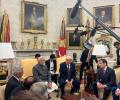
'Trump is not shy when he is frustrated with countries'

Stock markets are in for an event-heavy week ahead with a raft of Q1 earnings from blue-chips, the US Fed interest rate decision and foreign investors trading activity driving investors' sentiment, analysts said. Macroeconomic data announcements, monthly auto sales numbers and global market trends would also guide movement in the domestic equities, they said.
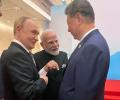
The relations between New Delhi and Washington are on a downturn after Trump doubled tariffs on Indian goods to a whopping 50 per cent, including a 25 per cent additional duties for India's purchase of Russian crude oil.
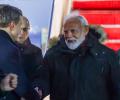
India and the United States will be signing a new defence framework during Prime Minister Narendra Modi's ongoing visit to the US, which will give a further fillip to the partnership between the two countries, a senior White House administration official said on Thursday.

A meeting with Chinese President Xi Jinping on the sidelines of the SCO summit is being planned.
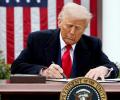
"We are contributing about 18 per cent, which is more than the US where the contribution is expected to be much less -- about 11 per cent or something. We are doing very well and we will continue to improve further," RBI governor Sanjay Malhotra said, replying to a question on Trump's recent comments.
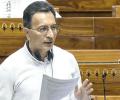
The United States did not accept India's request for consultations under an agreement of the World Trade Organisation (WTO) concerning American tariffs on steel, aluminium, and related derivative products, Parliament was informed on Tuesday.

Besides colourful costumes, ethnic jewellery and the mandatory dandiyas, there's one more thing that is becoming de rigueur every Navratri.

Titan, HCL Tech and State Bank of India were also among the laggards. However, Hindustan Unilever, Asian Paints, ICICI Bank, Power Grid, HDFC Bank and ITC were the gainers.

In an event-heavy week, stock investors will track quarterly earnings of several bluechip firms, the likely outcome of ongoing India-US trade talks, and inflation data for market cues, analysts said on Sunday. Moreover, global market trends and trading activity of foreign investors would also guide movement in equities, they said.
Trading sentiment in the stock market this week will be guided by quarterly earning announcements from blue-chips such as Infosys and Bajaj Finance, the outcome of India-US trade talks and global cues, analysts said. Markets may on Monday react to the quarterly results of three heavyweights - Reliance Industries, HDFC Bank and ICICI Bank, an expert said.

The defence minister also announced that India has taken up the challenge of developing a powerful indigenous aero-engine, adding that preparations for this critical project are now almost complete and the work will soon be visible.

'India is cosying up to Xi Jinping. They don't need the Russian oil. It's a refining profiteering scheme.'

US Vice President J D Vance and his wife Usha arrived in Delhi on Monday for a four-day visit. They were welcomed by Union Minister Ashwini Vaishnaw. Vance's visit comes amid ongoing trade talks between India and the US. Prime Minister Narendra Modi will host a dinner for the Vances on Monday evening after holding talks with the US Vice President. Vance and his family will also travel to Jaipur and Agra during their trip.

Official sources said Modi also congratulated Trump on the performance of his Republican Party in the US Congressional elections, as both leaders affirmed that they would work together for world peace.
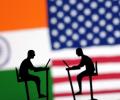
Commerce and Industry Minister Piyush Goyal on Tuesday expressed hope that India will conclude the proposed bilateral trade agreement (BTA) with the US by the fall or November this year. He said that "a little bit" of geopolitical issues overtook the trade matters in the negotiations for the pact between the two countries.
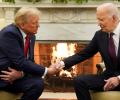
'As far as skilled immigration is concerned, the US needs Indian skills and Indian talent, and there are no two opinions about it even among US companies.'
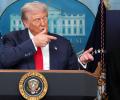
In trade negotiations, as in chess, sometimes you need to accept a temporary disadvantage to secure a better long-term position, points out Sonal Varma, chief economist (India and Asia ex-Japan) at Nomura.

The way to deal with a bully is to resist bullying, because submission in the first instance only invites even more overbearing demands in future. What may seem like a small price to pay now will lead to a much higher price later, warns former foreign secretary Shyam Saran.
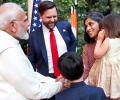
Prime Minister Narendra Modi and US Vice President JD Vance have expressed satisfaction with the progress made in negotiations for a bilateral trade agreement. The two leaders met in New Delhi and discussed a range of bilateral issues, including cooperation in energy, defense, strategic technologies, and other areas. They also exchanged views on regional and global issues of mutual interest.
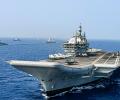
'It brings precarious peace because the red lines have shifted. 'The next Pahalgam attack would mean a full scale war.'
'Personalities are temporary, policies provide for stability.' 'With the former, when personalities change so does the nature of the relationship.' 'Policies and structures, on the other hand, are idiot-proof, as well as maverick-resistant,' explains Saisuresh Sivaswamy.
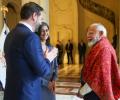
Vance is expected to be accompanied by at least five senior officials, including from the Pentagon and the State Department, the people cited above said.

India's pharmaceuticals and medical devices industries are still hopeful that trade negotiations with the US could cut a fairer deal for both sides, after President Donald Trump announced a 25 per cent tariff rate on India on a social networking platform without divulging the finer details.
IndusInd Bank, Nestle, UltraTech Cement, Mahindra & Mahindra, Power Grid, Asian Paints, Sun Pharma and Tech Mahindra were also among the laggards. Bajaj Finance, Bharti Airtel, ICICI Bank, Adani Ports and HCL Tech were among the gainers.
